Monday, May 06, 2013

Notes from the workbench

Spring is in full swing here and the weekends are full of the sounds of the season…lawn mowers, hedge trimmers, circular saws, hammers, paint sprayers, and cordless drills. It seems like all of suburbia is turning out to work on home improvement projects, and nowhere is that more clear than the hardware stores.

I found myself in one of the big box stores over the weekend (I think it was the green one, but it might as well have been the blue one or the orange one.) Mad-house doesn’t even begin to capture the scene. There were no unused carts to be found in the store when I arrived. They were all being filled with garden tools, laws spreaders, 2x4s and power tools. Watching people pile prepackaged tool sets into their carts reminded me of something I read in an old book.


 Back in 1924 Henry Saylor wrote a book called “Tinkering with Tools,” and in it he attempted to describe a proper home shop workbench.
My envy is all too frequently aroused by those marvelously equipped cabinet benches that the hardware store displays as its center of interest in the holiday window. Folding doors are thrown back, bristling with tools of every conceivable kind; the top lid is raised to display supplementary racks of more tools; drawers and cupboards of such an arsenal must be an inspiration sufficient to keep the home craftsman aware from meals, sleep, and family life, while he creates masterpieces in wood. Strangely enough, I have never known a man who possesses one. Perhaps the man does not live who dares buy one and face the responsibility it seems to entail. He would be left absolutely without an alibi for the neglect of anything that henceforth needed attention in the household.
Mr. Saylor may have been poking fun at the hardware stores and their attempts to commercialize the amateur craftsman, but I suspect he’s dangerously close to a sore spot. Take a close look around and I bet you’ll find any number of houses with dripping faucets, drooping cabinet doors, stuck windows, dead electrical outlets, and all of the tools needed to fix these things idle in the garage.

There are some people in the world who have access to a fraction of the tools being wheeled out of box stores and yet they work wonders with mechanical systems most people could only gawk at. I know of one gentleman in particular who spent many years in a little factory on the equator. If you wanted something fixed you asked Mr. Mac, and he would get out a toolbox about two feet long and less than a foot in the other two directions. It was full of simple tools, many of them modified for specific purposes. Trimmed down wrenches, home built hammers, hand whittled pry bars made up to fit odd angles and tight spaces all rested amongst an assortment of well worn sturdy hand tools. Regardless of what you needed done, he would go to that toolbox and find exactly the tool he needed for the job.

Many of us could take a lesson from Mr. Mac and his toolbox. I know I have a backlog of repairs to make around the house. I also have enough tools in the basement and garage to keep me from having any excuses.


There’s the normal assortment of wrenches, hammers, and pry bars. Most are pretty generic, people have forgotten that a pipe wrench is really a Stillson wrench. The pry bar apparently has a name too, but I think whoever came up with it was either from Germany or else he moonlighted thinking up undergarment names for women’s clothing.


Of course I have a small assortment of soldering irons, guns, and torches, but this little beauty tops them all.


Resistance soldering units are a bit like the butt welders of the soldering world.  They pass current through the joint to be soldered and the resistance creates very localized heat to melt the solder.  That all works very well on paper, but if you don’t get the contact-switch on-smoke-switch off-release sequence right you can easily go from soldering to spark eroding. 


Of course the lathe and the milling machine are great tools, but don’t forget the distant cousin the die filer.  Well this one is actually a bench-top filer.  My parents managed to nab this at an auction several years ago, which is very neat since you seldom see these anymore.  What do you need this for if you can do the filing by hand?  Well unless you have a wire EDM machine in your basement, this is one of the best options you have for making a square hole.  (Can you say falling block?!)

And then there’s the shop-smith.  My grandfather picked this up for a fraction of the original cost and put it to use for several years.  These are solid machines with simple mechanisms and few weak points.  Even better, you can still get spare parts, and plenty of online help for rebuilding them.  
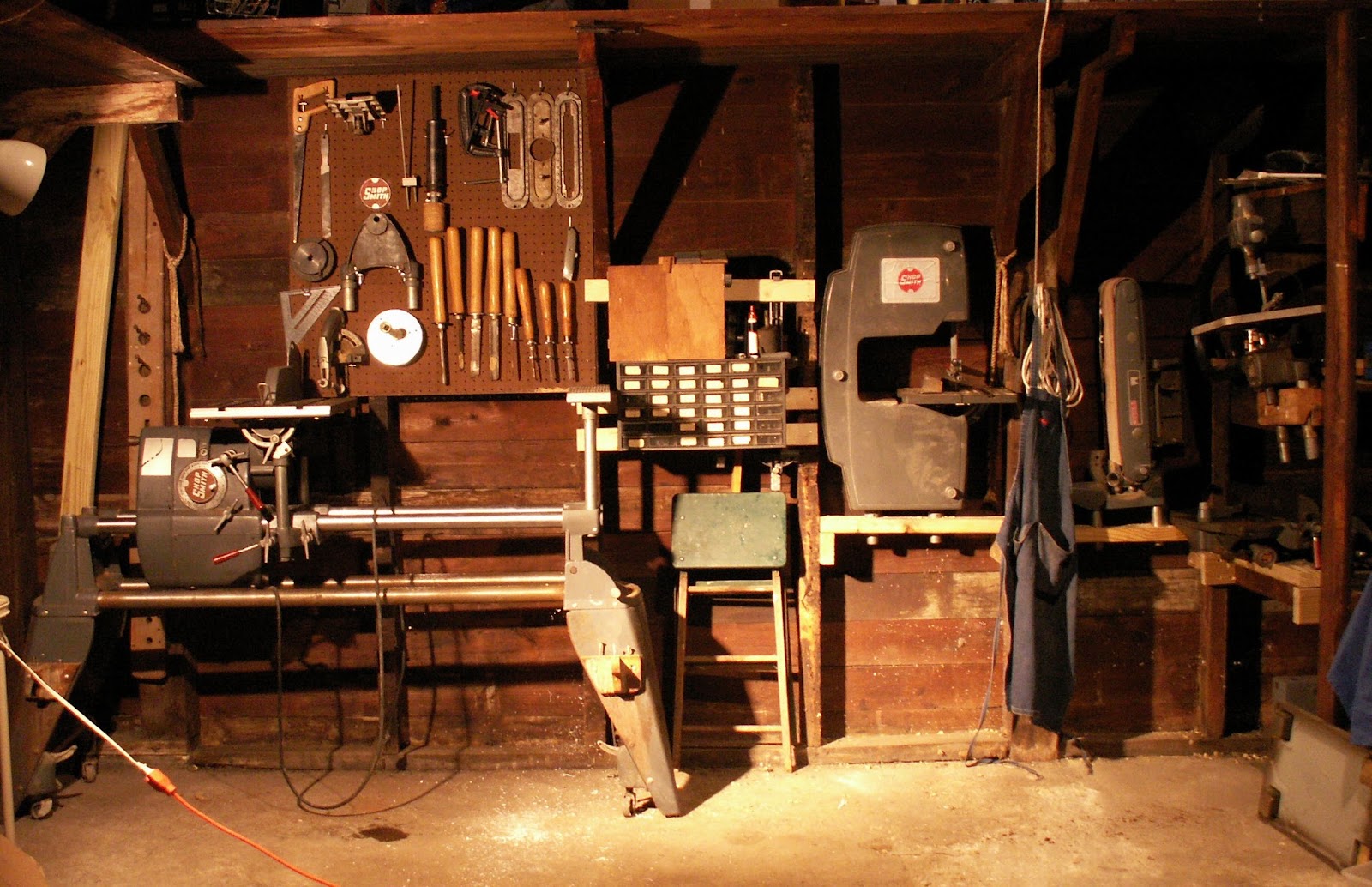

Some serious woodworkers might scoff at multi-machine systems like this but they’ve probably never been able to roll a table saw, woodlathe, shaper, sander and drill press around their garage with just one hand!


Really though, the most important tools I have aren’t in the garage or the basement shop.


A little knowledge and some ingenuity go a long way towards accomplishing things whether or not you have the tools you want. These books are full of tips and tricks that you can apply to all kinds of situations, and once you start thinking a bit sideways about how to do things it’s easy to improvise.


There was one time in a factory (in the middle of nowhere) when a well meaning mechanic broke off a pipe fitting in the end of a large manifold. He and some of the other mechanics tried desperately to remove it so they could get machine running again. I asked them where to find an easy-out and was, not surprisingly, met with blanks looks. I watched not-so-patiently while they attacked the broken bit of fitting with vise grips, small grinders, files, hammers, and punches. As they wore themselves out, my patience wore thinner until I finally I started digging through the toolbox (note the singular noun) at our disposal. I didn’t find much of use, but I did manage to come up with a wrench, a hammer, and a square piece of aluminum. I coaxed the mechanics out of the way and then proceeded to drive the aluminum bar into the fitting. Once that was done I put the wrench on the bar, gave it a twist, and out came the remainder of the fitting. I showed it to the mechanics and walked off while they stared at me as though I were from another planet.


That bit of a broken fitting is the only souvenir I brought back from that trip.  It rests on the shelf with some other keepsakes, reminding me of how much can be done despite limited resources.

Sunday, December 23, 2012

It needed to be said

This isn't the sort of thing that you really want to hear, or even say right before Christmas. I just think it needed to be said, because the people who should be making such statements are not willing to do so.

Last Friday I watched the news as reports poured in about the tragedy at Sandy Hook. The initial reports were muddled, confused, and would mostly be rewritten in the following days. There were two things, however, that became very clear; Something truly horrid had occurred at an elementary school in CT and it was going to be a political football used to create a new assault weapons ban.

The families of the victims deserve better than that. In fact all of the people who's lives have been impacted by media and politically exploited crimes deserve better.

Look at these faces.


These are men who killed innocent people. Not one of these men was forced to pick up a gun and shoot people. They CHOSE to commit atrocities. Regardless of how they came to be this way, they are evil. They are not the only ones.

You can try to make people feel safer by outlawing black rifles. Evil people will still exist. They will use any means available to bring harm to others. The modern world is full of tools that can be used for constructive or destructive purposes. Cars can become weapons, gas can become Molotov cocktails, fertilizer can become explosives, and planes can become guided missiles. You can't get rid of technology, and all the laws in the world won't stop determined people from using it.
What you can do is accept that there are bad people in the world, prepare yourself as best you can to deal with whatever evil confronts you, and because you can never be prepared for every possibility, learn to cherish each day you have and the good people that you share it with.

Sunday, December 02, 2012

It's a Trapdoor!

As members of blogosphere go I'm not exactly your model citizen. I'm probably the real world equivalent of the guy who lives in the old house down the block with the 'no soliciting' and 'no trespassing' and 'beware of owner' signs. People who've met him might say he's nice, but aside from the mysterious black truck parked there once in a while, there's no evidence he even exists. I suppose that's what I get for trying to do so many things in the other parts of my life, I just don't get around to posting very often.

 Case in point. I've have a bunch of pictures from the Gun Blogger Rendezvous that I haven't even begun to post yet. I should have posted them some time ago, but I've only recently started going through them again to figure out what to say.

 Today I was flipping through them and stopped on this shot of Daily Pundit showing off his California compatible SU16-CA and it occurred to me how much firearms have changed over the past 150 years.


 The last one hundred years have mostly been about development of semi-automatic rifles which, for most situations, have brought us to the practical limit of rate of fire for an weapon carried and handled by an individual. That race for more firepower really kicked off around 1918 when the Pedersen device made it possible to give soldier's a rapid firing magazine fed rifle at a time when many leaders had yet to figure out the futility of using bayonets for large scale assaults. It was a makeshift weapon and never proved itself in battle, but it pointed the way for weapons development.


 Looking further back there are a plethora of different designs which, if viewed all together might make you wonder about the sanity of the inventors, but there is a fascinating if not all together logical progression to the development between the 1860s and 1910. Take for instance this display I saw on one of my visits to the UK. It was in the "King's Own Border Regiment" museum which is on the grounds of Carlisle Castle.


This Lee Metford rifle contains most of the components of a modern bolt action rifle and it made a significant advance for a battle rifle by using a detachable box magazine, something which would set the stage for semi-auto and full auto battle rifles. It was first adopted for service in 1888.


Going back a bit further you saw the the Martini Henry rifle which began its service with the Brits in the 1870s. It's a single shot, falling block action which, despite some early design problems, was both sturdy and reliable. What's interesting about this rifle is that it was actually a big technological leap from many of it's predecessors because the lock mechanism and breech were integrated into a receiver. That may not seem like much, but virtually all of the military arms up until this time were designed in the traditional "lock, stock, and barrel" style where the three major components of a rifle were mostly independent of one another. Making a military rifle without a separate lock was a pretty radical change and was not likely to be easy on the armorers.


If you went back just a few years further, you would find this Peabody conversion rifle (I might be confusing this with a Roberts, but I think I have it right) which also had a falling block style action, but was based upon (and in fact made from) older muskets with a separate lock mechanism. The lock mechanism (mounted on a plate and fastened by two screws) was virtually identical to the locks dating back to flintlocks. The rifle itself was put together much the same as previous models with the exception that the barrel had a breech locking mechanism on it. There's a good reason for this type of similarity. Many of the early breech loaders were converted from muzzle loaders. Typically the rear of the barrel would be milled open at the rear and then fitted with a breech block of some sort and a firing pin or percussion nipple that was struck by the hammer. The lock and trigger didn't actually require modification to make this change.


A similar example would be the Snider conversion, which was a standard rifle in England for many years. It too used an older style lock mechanism and a barrel modified with a breech block that pivoted out to one side. The pivoting breech block would not have been as strong as a falling block action (meaning chamber pressures were low by today's standards) but it required very little modification to the stock and so it was a cost effective way to use the crates full of muzzle loaders found in most military arsenals.

Of course, if you start digging into transition rifles of this type you'll probably find a dizzying array of designs. So far I haven't even been able to identify this one, but from the looks of it, it's a 'trap door' style percussion design with a large locking lever over the top.

(Apparently rifles of this vintage are naturally blurry; no blame can be laid upon the cameraman)

The US went through it's own transitional phase, though at a slightly different pace. At the end of the Civil War it was obvious to many military minds that muzzle loading rifles were a thing of the past, but there were large stockpiles of them left over from the war. In 1865 the first model Allin converted rifle (named for it's creator) was established. It was quickly followed by an 1866 model when the original design was found to be somewhat lacking. The conversion essentially consisted of milling open the back of the barrel and pinning in a breech block. But unlike the Snider conversion used by England, the hinge pin was at the front of the breech block so the block flipped forward rather than to the side. These conversions were used for a few years and the design was well enough accepted that in 1873 a new model trap-door rifle was released.


 This is the model 1873 Springfield trapdoor. It was designed in the same style as the earlier Allin conversions but chambered in .45-70 rather than slightly larger .50-70. A few variants of this model exist, the most valuable of which would be the cavalry trapdoor, due largely to it's association with Custer's final adventure.

This basic design and the .45-70 cartridge were used by the US army right up until the 30-40 Krag became standard in the 1890s. That means the trapdoor design lies astraddle the transition from black powder to smokeless powder. That creates some problems!


 The 45-70, being developed for black powder, could pretty much be loaded by scooping the cartridge full of black powder and stuffing a bullet on top. There was simply not enough room to get more black powder into the cartridge, so the design was self limiting as far as pressure was concerned. The trapdoor style design was built to handle these pressures and no further thought was given to the matter. That is, until smokeless powders became commonly available. Most of these powders can pack more energy into a smaller space and consequently it was possible to generate much higher pressures and velocities from 45-70 ammunition. The capacity of the trap-door design was never built with this in mind.

I've heard people say that the 1873 design is capable of handling about 28,000 PSI or 25,000 CUP. A look at the Lee manual shows most of their "never exceed" loads are 15,000 or 16,000 PSI, which sounds safer to me considering these firearms are now antiques. However with most smokeless powders you can create much higher pressures in the roomy 45-70 envelope. In fact load tables for the Ruger single shot designs list loads up to 50,000 PSI. Naturally people with more modern firearm designs created hot loads to get more power and distance and the unintended consequence was that plenty of ammunition is available which the old fashioned Springfields are not able to handle.


Anyone that owns one of these should be very discriminating about the ammunition they use. Most commercial ammunition will be clearly marked if it is too hot for a trap-door design, but you should still investigate find out the chamber pressures you're dealing with.

Even when loading to proper levels, these firearms should be handled with significant care and attention. This one has a cartouch mark that says 1882, which makes it 130 years old, and even though the bore is good, that's no guarantee that it's still safe. It's best to have a gunsmith check your rifle over, looking for wear and cracks around the hinge pin, latch pin, and hinge lugs to make sure nothing is about to fly apart. It's also a good idea to check the headspace (an easy matter since the cartridge headspaces on the rim) just to make sure you don't give the cartridge too much room to bounce around.


Now that I've scared you enough you can relax a little. These rifles are still readily available at most gun shows and often at reasonable prices. Huge numbers of these rifles were surplussed out in the early 1900s and they were a favorite for hunters. Sadly many of them were 'sporterized' by cutting down the stock, changing sights and re-blueing, but they are still lovely relics from a time when firearms technology was making it's first steps towards the modern rifle.

Sunday, November 04, 2012

And I approved this message.

There will be no pictures in this post, only words.  We'll begin with a few well chosen ones from Thomas Paine.

"Some writers have so confounded society with government as to leave little or no distinction between them; whereas they are not only different, but have different origins.
Society is produced by our wants, and government by our wickedness; the former promotes our happiness positively by uniting our affections, the latter negatively by restraining our vices . . . The first is a patron, the last is a punisher." 

The truth of these words has been recognized and echoed by many others since.  Even 180 years later, the fictitious, Dr Ferris encapsulated this idea in the simple statement,
"There is no way to rule innocent men.  The only real power government has is to crack down on criminals." 

Yet somehow, a new beast has emerged, or rather, wedged itself into the role of government.  I'll call it the caretaker.  It is different from the soldier, the judge, the policeman, and the lawmaker.  They are actually needed to govern a country, or in more precise terms, to regulate it.

The caretaker serves a different purpose.  He does not concern himself with what is just, but what is needed.  This may seem innocuous enough, but then comes the question of who's need is to be served.  Whats more, one must then decide what actually comprises a valid need.  When elected officials are allowed to make these decisions, people who wish to be elected to an office are natually inclined to define need in a way that will secure the most votes.

I suspect many people understood this first half of the caretaker system, from the onset of our current form of government.  What seems to be less understood is that the elected caretaker does not provide for the needs of any citizen without first taking from another.  If something is actually free, there is no need for government intervention in the first place.  If something has value, it is not created by a conglomerate entity like a government.  Value is created by the minds and the efforts of individual people, sometimes working alone, sometimes working in concert with one another.  Sure governments can print money, but that only has value if people place value upon it.  If anyone, including a government department, starts indiscriminately printing and giving away money, sooner or later people figure out that its worth no more than paper.

When we accept the idea of a government caretaker as a legitimate provider of services, goods, and even money, then the question that arises every election day is, "who is the best caretaker."  The answer, except in rare cases, is "The one who 'provides' the most for his voters."  In order to provide more, he must find more sources from which to take, and so each election beomes a sort of race to see who can promise voters a bigger piece of what others have earned.

H. L Meneken* reognized this at the dawn of the roaring twenties.

"Government, is a broker in pillage, and every election is a sort of an advanced auction sale of stolen goods." 
I particularly appreciate the use of the word 'pillage' because it strips away all of the re-branding that has turned 'seizing' into 'taxing' and 'loot' into 'financial support'

The only things that keep such systems running year to year are the desire for the unearned, and the incomprehensible complexity of their operation. If we could all see where every penny of our tax money went, I guarantee that each of us would identify some recipients we believe to be undeserving of our money, and some administrative practices that are wasteful.  But when you have tax codes so complex that even accountants need specialists to interpret it, and politicians who talk about the good they have done for 'the country,' 'the community,' 'the unfortunate,' or some other loosely defined entity,  it becomes nearly impossible to see where your money goes to or comes from.

How does all of this pertain to the elections in 2012?  Frankly, I don't know how much long term impact this election will have on us all.  As with most elections, it will determine who gets pillaged and who gets the loot for the next few years, and it will have some impact on how much deeper we go into debt.  Sadly though, both parties are focused heavily on 'winning votes' and seemingly less concerned with ideologies. If I were a cynic I might compare it to a choice between riding in one handbasket or another, but at least there is still a choice to be made and we should consider the consequences as carefully as possible.

Each election gives us an opportunity to reflect upon the reasons for selecting one candidate verses another.

Ask yourself, "Is this person promising to be my caretaker?"

If so, he probably has no place in government.  As I said in the beginning, there are roles in government for soldiers, policemen, judges, and lawmakers.  There are plenty of derivatives and supporting roles that come with these, but caretakers, false providers, and other such 'charitable' individuals are not among them.

Please vote accordingly!

*Meneken was often an opponent of both democracy and religion, though I believe he would agree, their biggest flaws are typically their practitioners.

Sunday, September 09, 2012

Bang up time

Wow, what a weekend!

I'll explain more when I have a chance to write it up properly, but here's a quick run down of what we had a the Rendezvous.

Range time


Steel shooting


Guns...lots of guns!


Fun with lasers

(I wonder why the wait staff always knocks before they come in?)


Bad puns


Distinguished Guests


Distinguished guests with pink gear


Lots of swag


Fabulous prizes

Made possible by contributions from Hi-Point, Ruger, Leupold, Sig Sauer, CrimsonTrace, CompTac, Brownells and more!

Happy winners


Really happy winners


Gunsmoke


Lots of cowboys


And of course...

Let's not forget the real reason we all met in Reno this weekend. 


We were here to raise money and support for Soldiers' Angels and Project Valour-IT.  Even if you couldn't make it, you can still support SA.  Just pay their website a visit and see what you can do.

Wednesday, August 22, 2012

Big news...small caliber

I mentioned in my last post that Lori from Ruger wanted to donate a firearm in Bea's honor to the fund raiser raffle at this year's Gun Blogge Rendezvous. Well we owe Lori a big thank-you because right now I'm holding in my hand a certificate for a new Ruger Single Ten!


Now I've not used a single ten before, but I have used the single six before and it's a loads of fun, so having 66% more ammo per cylinder has to be pretty darn cool. But don't take my word for it, check with somebody who's actually used one.


The single ten is the new addition to the single action line, coming out a little over a year ago and I'm very excited to have one in our raffle this year.

 For those of you who haven't used a single ten or single six I know you might be saying "what's the big deal, it's a .22LR in a revolver."  I'll forgive your skepticism for a moment if you just stick with me.

 Rimfire revolvers are actually pretty versatile. No, you don't want to rely on them for bear protection, but they're actually really good firearms for those who love the great outdoors because of the inherent reliability and ruggedness of the revolver design. They're also nice to pack around because you don't have to worry about fiddling with safeties, magazine releases and such; you just load it, holster it, and it's there whenever you need it. (And with Ruger's transfer bar system you don't have to leave a chamber empty like you did on old style single actions)

Or if you just want a plinker, with this you can spend all day shooting paper, tin cans, and those annoying plastic political signs that grow in the yard this time of year. But what's this...You get four more shots between stopping to reload! I wouldn't swear to it, but I bet that with a little practice, you could reload one of these almost as fast as you could stuff some of the more annoying 22LR magazines out there.

And lest I forget the really fun part, with those four extra rounds, you also get a single action revolver that can shoot steel! Sure you won't beat the automatics in a drag race, but with a little practice you could turn in some respectable times in Steel Challenge style contests, oh and you can also tease your buddies about how their their self-cocking, auto-feeding pistols are doing all the hard work for them!

 So if you haven't sent in your registration yet, go over to Gunbloggers and send it in now. If you participate in the raffle you'll be helping Project Valour-IT and you might just get a Single Ten as your reward!!

And don't be afraid to show a little appreciation to the folks over at Ruger for making this possible!

Load and Make Ready!

I have exciting news to post when I get home tonight.  Stay tuned!

Wednesday, July 18, 2012

Just 7 Weeks!

Seven weeks and counting folks!


If you don’t know what I’m referring to then you had best check out this post and learn all about the Gun Blogger Rendezvous. For the last several years, Mr. Completely and Keewee have been putting on the rendezvous and It’s gotten progressively better each time I’ve attended.

Now I know that the name implies that it’s for gun bloggers, but it’s actually a good time for anyone who enjoys shooting, hunting, competitive shooting, or even just talking about guns. We have some attendees who don’t even have a blog (and people like myself who have one but never post) and they join in the fun just like anyone else.

Typically Mr. C puts together a few different activities and all end up being fun. There is usually a show and tell session where everyone gets to bring out their toys for others to admire. We’ve been lucky to have various guest speakers from the firearms industry, various firearms and sporting groups, as well as some distinguished advocates for gun owners’ rights. (see here and here)


Then there are the range events. We typically have an open range day where everyone sets up their gear, does some shooting, then goes down the line to admire (and try out) everyone else’s guns. The miniature Steel Challenge event gives everyone a chance to try their hand at steel plates. (We do log times, but there’s really no pressure. We’ve even had people shoot stages with single action wheel guns.) As if that wasn’t enough we’ve also had cowboy fast draw competitions which are fun pretty much no matter what


And last but not least we have a raffle.


“A raffle, you say? What’s the big deal?”

It’s actually a very big deal. First off it’s for a very worthy cause. All of the money raised at the GBR goes to Project Valour-IT, a very Soldiers’ Angels program which provides voice controlled laptops and other technology aids to wounded soldiers so that they can maintain communications with friends and loved ones.


If that isn’t enough of a reason, then remember, you can win cool stuff! Last year I won a pistol and several other people won firearms as well. There were pocket knives, gun gear, clothes and all manners of goodies to enjoy.


That brings me to my main point for today. I’ve been in communication with Lori Petoske from Ruger and I’m making arrangements for a Ruger Vaqueros to be in this year’s raffle. What’s more, Lori came back with a very generous offer.

If you’ve followed the GBR, you probably know that Lori and Bea met a couple years ago during the 2010 rendezvous. From what I hear, they had a blast! The following year Bea donated a Ruger Blackhawk like the one she enjoys shooting. Well this year Lori says she and the fine folks at Ruger are interested in donating a firearm in Bea’s Honor!

We have to work out the details but it looks like there will be TWO Ruger firearms in the raffle at GBR this year.


Now what are you waiting for? Go register for the rendezvous, help raise some money for Valour-IT and maybe even win a Ruger!!

Sunday, July 08, 2012

Sometimes I don't know...

...if I'm coming or going!
 Just a quick post to say that I'm still alive. I'll post again soon, but in the meanwhile, here's a picture of a rare beast; a Garratt steam locomotive!