Thursday, July 26, 2007

For pet owners servants


How to Give A Cat A Pill
  1. Pick cat up and cradle it in the crook of your left arm as if holding a baby. Position right forefinger and thumb on either side of cat's mouth and gently apply pressure to cheeks while holding pill in right hand. As cat opens mouth pop pill into mouth. Allow cat to close mouth and swallow.
  2. Retrieve pill from floor and cat from behind sofa. Cradle cat in left arm and repeat process.
  3. Retrieve cat from bedroom, and throw soggy pill away.
  4. Take new pill from foil wrap, cradle cat in left arm holding rear paws tightly with left hand. Force jaws open and push pill to back of mouth with right forefinger. Hold mouth shut for a count of ten.
  5. Retrieve pill from goldfish bowl and cat from top of wardrobe. Call spouse from yard.
  6. Kneel on floor with cat wedged firmly between knees, hold front and rear paws. Ignore low growls emitted by cat. Get spouse to hold head firmly with one hand while forcing wooden ruler into mouth. Drop pill down ruler and rub cat's throat vigorously.
  7. Retrieve cat from curtain rail, get another pill from foil wrap. Make note to buy new ruler and repair curtains. Carefully sweep shattered figurines and vases from hearth and set to one side for gluing later.
  8. Wrap cat in large towel and get spouse to lie on cat with head just visible from below armpit. Put pill in end of drinking straw, force mouth open with pencil and blow down drinking straw.
  9. Check label to make sure pill not harmful to humans, drink 1 beer to take taste away. Apply Band-Aid to spouse's forearm and remove blood from carpet with cold water and soap.
  10. Retrieve cat from neighbor's shed. Get another pill. Open another beer. Place cat in cupboard and close door onto neck to leave head showing. Force mouth open with dessert spoon. Flick pill down throat with rubber band.
  11. Fetch screwdriver from garage and put cupboard door back on hinges. Drink beer. Fetch bottle of scotch. Pour shot, drink. Apply cold compress to cheek and check records for date of last tetanus shot. Apply whiskey compress to cheek to disinfect. Toss back another shot. Throw tee-shirt away and fetch new one from bedroom.
  12. Call fire department to retrieve the friggin' cat from tree across the road. Apologize to neighbor who crashed into fence while swerving to avoid cat. Take last pill from foil-wrap.
  13. Tie the front paws to rear paws with twine and bind tightly to leg of dining room table, find heavy duty pruning gloves from shed. Push pill into mouth followed by large piece of steak. Be rough about it. Hold head vertically and pour 2 pints of water down throat to wash pill down.
  14. Consume remainder of Scotch. Get spouse to drive you to the emergency room, sit quietly while doctor stitches fingers and forearm and removes pill remnants from right eye. Call furniture shop on way home to order new table.
  15. Arrange for Humane Society to collect mutant cat from hell and call local pet shop to see if they have any hamsters.

How to Give a DOG a pill

  1. Wrap it in bacon.


Thursday, July 05, 2007

Little Chapel - Where?

I'm on vacation this week, so I drove down to southen Illinois to see the family for a little while. We decided to tour around the countryside one day and we ran across this sign.


I've seen little chapels/churches before. I know that when you see a sign for a little church you can usually expect something like this.


This is "The Little Brown Church" just north of Waterloo Iowa. It is a typical small country church.

But this is the Little Chapel Church of Southern Illinois


No, the little church is not behind that humongous building. That building really is The Little Chapel Church


After a closer look we determined that the building was about 400 feet long by 200 feet wide with 37 separate air conditioning units! There is also a day care center with a playground, a huge parking lot, and a bus barn.

I think the "Little Chapel Church" is a very nice name, but as a description it requires more than a little imagination!

Monday, July 02, 2007

Power to the Pulleys


In my old technology posts thus far I have talked about power sources, but i have yet to talk much about how this power is utilized. In the modern world where every little gadget, power tool, and machine seems to be driven by electricity, it's easy to forget that all of that power has to come from somewhere. Electric cords just blend into the background, and battery powered devices eliminate the cords entirely, but this is an incredible luxury compared to what was previously done to operate machines.


Look back at my post on the Aldie Mill in Virginia. You'll notice the power from the waterwheel is transferred directly to the millstones by way of large shafts and gears. This works well for one or two devices, but what if you want to transfer that power to multiple machines? When the mill was upgraded over the years, it began to use roller mills, similar to these. To completely process grains, you typically needed several units. In order to power them, the mill began to use line shafts.


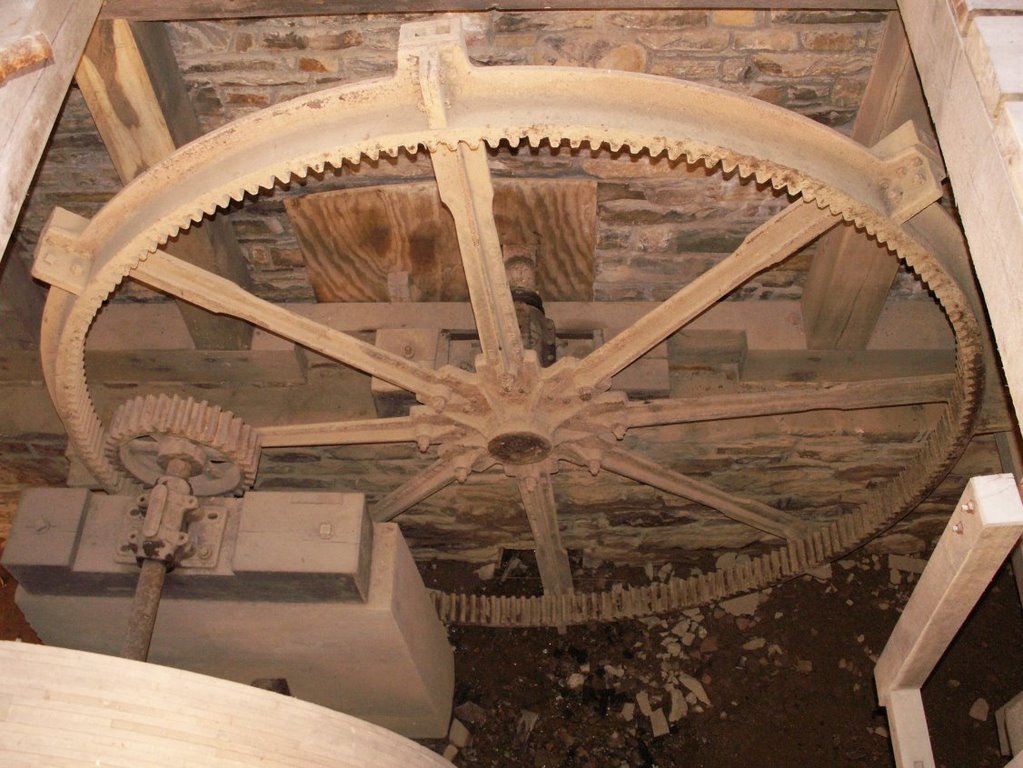
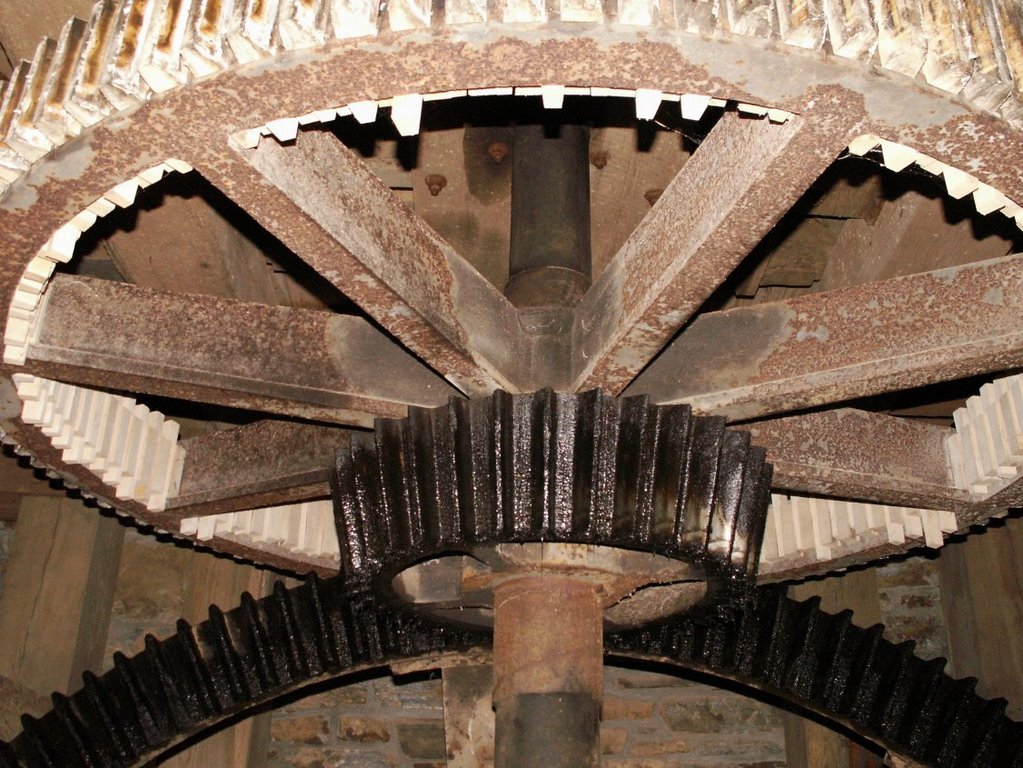
Here, one of the waterwheels is connected, by way of a large pair of reduction gears to a pulley. This would, when operational, have a large belt connecting it to a much smaller pulley on another shaft. That shaft could then be extended to nearly the length of the building. Wherever power was needed for a roller mill, fan mill, or other device, a pulley was placed on the shaft. That pulley, and another belt, would transfer power to the machine below.


Of course if you can do this with water, you can do this with steam or gas engines as well. This is why most older engines either had a large pulley attached to the crankshaft or else had a wide flat flywheel that could be used to run a belt.


To make this a little easier to understand, let's look at a model.


This miniature machine shop is made up mostly of kits from PM Research who display and sell their wares at the Old Threshers Festival. Here, a model steam engine is connected to a line shaft, via a belt.


This shaft runs the length of the building, and is connected to other shafts and machines, all of which could be powered by the engine at the same time.


Of course, this has some potential complications. Very seldom will all of the machines in a shop need to run at the same speed, yet when they are all running at the same time, you can't just change the speed of the steam engine to suit one particular machine. This is why different sizes of pulleys are used. Two pulleys of different sizes act in much the same way that two gears of different sizes will act. A large pulley when connected to a smaller pulley, will cause the smaller pulley to spin at higher RPMs. By using this knowledge, you can have a line shaft that spins at a set speed throughout a facility, and yet have machines running at various different speeds.


To complicate matters further, some machines needed the ability to be adjusted to run at multiple speeds.


You may notice in this picture that some of the machines shown have a pair of multiple diameter, almost conical pulleys. These are connected with a thin belt that runs between one pair of pulley diameters at a time. Adjusting the belt to one set of diameters or another, changes the diameter ratio and therefore the RPM ratio of each of the pulleys. So each diameter on each pulley represents its own speed, almost like a modern selectable gearbox. (Incidentally, if you make the pulleys perfectly conical then you would be creating a continuously variable transmission.)


Sometimes it was necessary to stop a machine entirely. This created another problem because nobody wanted to shut down an entire factory just to work on a single machine. It became necessary to isolate machines from the line shaft. I'm sure there were several possible methods for this, but the simplest was simply to move the belt to an idler pulley. Either on the machine or on the line shaft, a free spinning pulley could be mounted so that when a machine needed to be stopped, the belt was simply moved from the main pulley to the idler pulley, where it could not transmit any power. Similarly, a belt might be allowed to go slack, so that there was not enough friction between the belt and the pulley to transmit any significant force. Both methods worked, even though they were far from perfect.


Still, systems like this were used in all manners of facilities from machine shops and factories, to grain or textile mills, and other manufacturing facilities. Over the years, they would be used with waterwheels, steam engines, gas engines, diesel engines, and eventually, they would even be adapted to run under power from large electric motors.


The line shaft system did have drawbacks. All of the moving parts created plenty of friction, so efficiency suffered. It also required considerable time and effort to make sure that all of the line shafts were well maintained and lubricated. Safety was one of the primary drawbacks of a line shaft operated facility. Even though machines could often be disconnected, it was rare to completely shut down a system, so people were often injured by working on moving equipment or trying to put belts back on pulleys after they had slipped off. Unguarded belts and pulleys can be particularly hazardous because of their ability to catch appendages or loose clothing and pull people into moving equipment. The same can also be said for the line shafts themselves. Keeping out of moving machines required considerable care and attention, both of which were hard to come by in the typical old bustling factory.


All of these problems could not be ignored, and when electric motors became smaller, economical, and readily available, factories began using machines powered by electric motors instead. Sometimes, entirely new machines were purchased that had motors built in. In some cases though, shops would refit their existing equipment to run without a line shaft.


Here is an example of an old drill press that would originally have be run by a belt from a line shaft. It has since had an electrical motor mounted on it, which turns the pulley that was originally used to power the drill. The adjustable speed pulleys are still intact, and the old mechanism has not been changed. In fact, except for the motor and an on/off switch, this drill press is virtually identical to what would have been found in any old machine shop. Home made conversions like this one, no doubt offered a cost effective way of running old equipment, even when maintaining an old line shaft system became impractical.


Today, this sort of system has faded out of use in most places. Your best chance of seeing a line shaft driven shop would be in a museum. If you get the chance, though, it's interesting to see a shop like this in action.


For a much more mathematical look at this topic, take a look at the belt and pulley page over at Harry’s Old Engine

Monday, June 25, 2007

Perspective


I'm heading home from my latest trip very soon. (Singapore this time.) I'll need a couple days to get my feet back on the ground, but after that I have a brand new essay to put up, so stay tuned!

Friday, June 08, 2007

What kind of freight?


As strange as it may seem for air freight to go by truck, I think it would still be faster than waiting for flights right now. (I had the misfortune of picking a time and place to fly that corresponded directly to a national weather service thunderstorm warning.)

Tuesday, May 29, 2007

Quote of the unspecified temporal interval

True Blue Sam just referenced this quote. I think it's particularly appropriate considering the earlier post.

"For the want of a nail, the shoe was lost; for the want of a shoe the horse was lost; and for the want of a horse the rider was lost, being overtaken and slain by the enemy, all for the want of care about a horseshoe nail."


-- Benjamin Franklin

Fixed?


I know that necessity is the mother of invention, but these must be the red-headed step children.

Monday, May 28, 2007

Miss Me?

Once again, I'm back. Since my last significant post I've spent about 2 weeks in South Africa and some time in Ohio, but I'm back at home for about a week!

I'll be putting up a few posts soon, Starting with a brief essay I've been contemplating for a few months: The Mundane Detail

The Mundane Detail

If you’ve seen the movie ‘Office space’ then you probably remember the scene when the three main characters discuss how their money skimming scheme has gone awry and discover they will probably be going to prison. Michael, reveals what has given them away…

“I always do that. I always mess up some mundane detail.”
 

Yep, $300,000 and a prison sentence, traced back to a ‘mundane detail’

It’s the sort of thing that I have encountered too often. People don’t place value on things that seem simple or ordinary, but these are the things that often end up being important.

Shortly after I began my job, I was given a bit of advice. I was told that in spite of all the calculus and differential equations I had been taught in school, that the most important math skills to have were basic counting skills. Why? Because no matter how well you design parts, if you don’t order enough of them you’ll be throwing your work away. I realized this style of thought applied to many other things as well.

Here are a few examples.

It’s common for engineers to design a just few parts of a much larger system, in fact it is typically necessary because few people have the knowledge necessary to design an entire machine from the foundation up. One of the many problems arising from this is that incompatibilities may arise in a design. It’s worse yet if the parts cannot be tested, except at considerable expense.

In my first case, the parts being designed had to be taken overseas for testing. When they arrived, it was found that they were missing a feature that they required. It was a simple feature; three lines and a little text on the drawing would have solved the problem. But the parts had already been made when this was discovered. Even worse, tickets had been purchased, promises had been made to customers, and machines had been shut down in preparation for the testing. Three lines could have cost quite a lot of money if it hadn’t been for a stroke of luck in having a good machine shop nearby.

The second situation isn’t quite so nice. It involves a million dollar piece of equipment to be used as part of a much larger machine. It takes considerable work to properly install one of these, and there are plenty of other parts that are needed to complete the job. By comparison, these parts are inexpensive. A few hundred dollars worth of parts seems inconsequential compared with the overall price of the unit. If only that were true!

An error resulted in a few hundred dollars worth of parts not being shipped. Those parts weren’t available elsewhere, so when the shipment showed up without them it was a problem. There was no time to get more parts shipped, there was no local supplier, and no simple way to fix the problem. The only way to get around not having the right parts was to spend two days cutting holes in this million dollar piece of equipment while it was on the floor of a machine shop that is better suited to much less precise work. And that’s after waiting a day and a half for instructions from the engineering department, that had to be disregarded in the end because they were apparently not able to fully evaluate the situation from overseas.

The end result was a high potential for a botched installation, two or more days wasted production, and at least a man-week of time and labor thrown away. That’s worth quite a bit more than a few hundred dollars. And of course, whoever packed the boxes for the shipment, probably had no idea of the importance of those parts and the consequences of losing them. If every shipment was like that, he could go on shipping 99% of the parts that were ordered, and still leave all of his customers with a very low rate of satisfaction.

Mundane details like this are like quicksand, you’ll never know there’s a problem until you’ve stepped in it and start sinking. It’s an overlooked detail that partially responsible for my extended stay in South Africa. For what it’s worth, I was not the one who overlooked it, but that’s little consolation since things that aren’t my fault are often my problem.

Of course when forgotten details multiply, then things begin to look less like quicksand and more like a whirlpool. On a recent trial I had to rely upon four suppliers for parts and raw materials. The supplier I dealt with the most received a design which I had carefully checked, and I had multiple conversations to confirm the delivery date and address to insure that everything went smoothly. After all of that, things did indeed go smoothly, but not with the other suppliers.

One supplier made a part with a significant manufacturing error. Either through haste or misinterpretation of a drawing, the part was unsuitable for use without significant modification. (Modification that involved hand shaping metal that is supposed to be made to aerospace like tolerances. Talk about risky business!) That problem was solved, but there’s more.

The third supplier does much of their design work in house, and seldom provides details for fear of losing designs to other shops and therefore losing business. Because of this, it isn’t clear if the design was incorrect or if the manufacturing was simply sloppy with no inspection process. Either way, the equipment had to be jerry rigged to make it work, and as soon as the trial work was done it was boxed back up and sent back for rework. We lost time and the supplier will have to bear unnecessary expenses to correct the error. Still, the trial was still possible, or at least it was until the last supplier put the last nail in the coffin.

It turns out that some material shipped was unsuitable for the trial. Observations in the field indicated that it was probably not what had been promised prior to shipment, and might not have even been what its label said. We scrambled to do a few tests with other material, and we were able to confirm that everything else was working fine, but without large quantities of the requested material, the trial was essentially dead in the water.

All of the errors were simple ones that could have been avoided by a careful look at the parts that had been made or a little extra care in the manufacturing process.

Had I not been through trials like this before I think I would have been completely frustrated with the entire situation. Having a trial thwarted is bad, but having to solve all of the other problems first really adds salt to the wound. Still, there’s nothing to do but make sure everything is corrected then remember what went wrong so you can plan to avoid the problems in the future.

If there’s a lesson to be learned from this, I suppose it is that details can be simple, and even boring, and yet still be insanely important to your work or others, so try to stay sharp, and don’t overlook the little stuff.


An afterthought: I am not immune to this problem myself. I would like to comfort myself with the thought that the details I miss are more subtle than the examples listed here, but the truth is that nobody is perfect. Of course that doesn’t mean we can’t strive for perfection.